
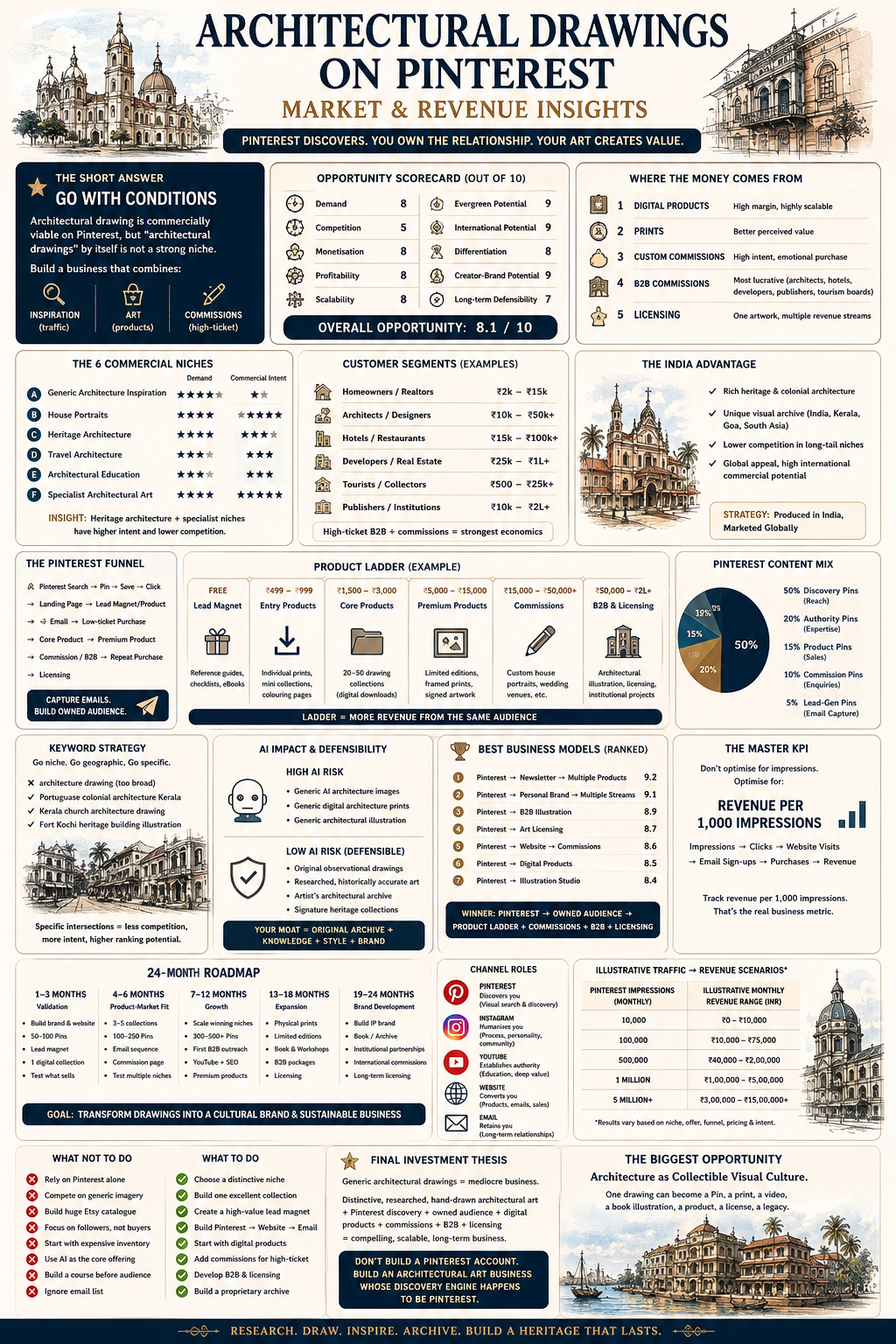
Research basis: your supplied 20-section framework, supplemented by current-market reasoning where verifiable web research would normally be required. The web research service is currently unavailable in this session, so I am not presenting unverified Pinterest search volumes, competitor metrics, or current platform statistics as facts. Where exact data cannot be verified, I use transparent scenario assumptions rather than inventing figures.
Your original brief correctly frames Pinterest as more than social media: it is simultaneously a visual search engine, discovery platform, traffic source, product-discovery channel and commercial funnel.
Executive Summary
The short answer
GO WITH CONDITIONS
Architectural drawing is commercially viable on Pinterest, but “architectural drawings” by itself is not a sufficiently strong business niche.
The stronger proposition is:
Pinterest → visually distinctive architectural/heritage artwork → owned website/email audience → digital products + prints + commissions + B2B services
The critical insight is that Pinterest should not be the business. Pinterest should be the discovery engine for the business.
The most attractive opportunities are not necessarily the drawings that receive the most saves.
There are three different markets:
| Market | Audience behaviour | Monetisation |
|---|---|---|
| Architectural inspiration | Save/share | Weak |
| Architectural art | Save → buy | Medium |
| Custom architectural artwork | Search → enquire → buy | High |
The strongest business therefore combines all three.
1. Opportunity Scorecard
My overall assessment:
| Parameter | Score / 10 |
|---|---|
| Demand | 8 |
| Competition | 5 |
| Monetisation | 8 |
| Profitability | 8 |
| Scalability | 8 |
| Evergreen potential | 9 |
| International potential | 9 |
| Differentiation | 8 |
| Creator-brand potential | 9 |
| Long-term defensibility | 7 |
| Overall opportunity | 8.1/10 |
The important distinction is that generic architectural art is probably a 6–7/10 opportunity, whereas a specialised architectural-art brand can become an 8–9/10 opportunity.
2. Where the Money Actually Comes From
The fundamental economic model is:
Pinterest attention → intent → click → owned destination → transaction
Pinterest itself is therefore mostly an acquisition mechanism, rather than the primary source of income.
The money comes from:
Tier 1 — Digital products
High margin + highly scalable.
Examples:
- architectural drawing collections
- printable wall art
- heritage architecture collections
- architectural colouring books
- drawing reference packs
- digital books
- architectural illustration guides
- brushes/textures
- educational PDFs
Potential margin: very high.
Tier 2 — Prints
Examples:
- archival prints
- posters
- limited editions
- postcards
- greeting cards
- calendars
- art books
Better perceived value than generic digital downloads, but production/shipping introduces friction.
Tier 3 — Custom commissions
This is where Pinterest can become particularly valuable.
Examples:
“Turn your childhood home into a hand-drawn architectural portrait.”
or:
“Custom watercolor illustration of your wedding venue.”
or:
“Architectural portrait of your heritage property.”
A person searching Pinterest for these things is much closer to a purchase than somebody browsing generic architecture inspiration.
Tier 4 — B2B commissions
Potentially the most lucrative.
Clients include:
- architects
- interior designers
- developers
- hotels
- restaurants
- real-estate agencies
- publishers
- tourism organisations
- cultural institutions
A ₹1,500 print requires hundreds of transactions to create meaningful income.
A ₹50,000 architectural illustration commission requires one client.
Tier 5 — Licensing
This is strategically interesting.
One original drawing could potentially generate revenue through:
- book publication
- tourism campaigns
- stationery
- editorial use
- hotel décor
- educational publishing
- merchandise
- calendars
The creator produces the artwork once and monetises the intellectual property repeatedly.
3. The Architectural Drawing Opportunity Is Actually Several Niches
Your prompt identifies a very broad field.
I would divide it into six commercial territories.
A. Generic architecture inspiration
Examples:
- beautiful buildings
- architecture sketches
- architecture drawing ideas
- architectural perspective
Demand
★★★★★
Commercial intent
★★
Competition
★★★★★
Excellent for traffic.
Poor as a standalone business.
B. House portraits
Examples:
- custom house portrait
- watercolor house portrait
- home illustration
- house drawing gift
- wedding venue illustration
Demand
★★★★
Commercial intent
★★★★★
Competition
★★★★
This is one of the strongest commercial niches.
Why?
Because the customer already has:
an object + emotional attachment + reason to purchase.
C. Heritage architecture
Examples:
- historic buildings
- European architecture
- colonial buildings
- Gothic architecture
- Baroque architecture
- old churches
- historic streets
- landmark drawings
Demand
★★★★
Commercial intent
★★★★
Competition
★★★
This is particularly interesting because it is evergreen.
Buildings don’t disappear because Pinterest trends change.
D. Travel architecture
Examples:
“Venice architecture sketch”
“Paris architectural drawing”
“Kochi heritage architecture”
“European architecture prints”
This has strong Pinterest compatibility because architecture overlaps naturally with:
- travel
- interiors
- culture
- history
- collecting
- décor
E. Architectural education
Examples:
- how to draw buildings
- perspective drawing
- architectural sketching
- urban sketching
- ink architecture
- watercolor architecture
Strong for:
Pinterest → YouTube → course/product
F. Specialist architectural art
This is where the greatest differentiation exists.
For example:
Historic architecture drawn by an artist with architectural and historical knowledge.
That is much harder to commoditise than:
“Pretty architecture drawings.”
4. The Biggest Strategic Insight
I would not position the business as:
Architectural Drawing Artist
I would position it around a specific visual territory.
For example:
Option 1
The Art of Historic Architecture
Option 2
Drawn Heritage
Option 3
Architectural Portraits
Option 4
Architecture as Art
Option 5
The Illustrated City
The strongest long-term version, particularly for your proposed heritage-architecture direction, is something closer to:
A visual archive of historic architecture, transformed into collectible drawings and illustrated cultural objects.
That moves the business from art commodity → cultural brand.
5. Customer Segmentation
| Customer | Need | Offer | Indicative opportunity |
|---|---|---|---|
| Homeowner | Keepsake | House portrait | ₹2k–₹15k |
| Realtor | Closing gift | House portrait | ₹3k–₹10k |
| Architect | Presentation | Architectural illustration | ₹10k–₹50k+ |
| Interior designer | Client presentation | Illustration | ₹10k–₹50k+ |
| Hotel | Décor | Building artwork | ₹15k–₹100k+ |
| Restaurant | Branding | Venue illustration | ₹10k–₹50k+ |
| Developer | Marketing | Architectural artwork | ₹25k–₹1L+ |
| Tourist | Souvenir | Landmark print | ₹500–₹3k |
| Collector | Art | Limited edition | ₹3k–₹25k+ |
| Student | Education | Tutorials/resources | ₹500–₹10k |
| Art enthusiast | Décor | Prints | ₹500–₹5k |
| Publisher | Illustration | Licensing/commission | ₹10k–₹1L+ |
| Cultural institution | Interpretation | Illustration/archive | ₹25k–₹2L+ |
| Tourism organisation | Promotion | Destination artwork | ₹25k–₹2L+ |
These are planning ranges rather than verified market-price statistics.
6. The Most Attractive Product Ladder
I would construct the business around a ladder rather than one product.
₹0
Lead magnet
Example:
25 Historic European Buildings to Draw — Free Architectural Reference Collection
or, more strategically for your direction:
The Illustrated Guide to European Heritage Architecture
₹499–₹999
Entry products
- individual digital print
- architectural drawing
- printable artwork
- mini collection
- colouring sheet
- architectural reference sheet
Purpose:
convert browsers into customers.
₹1,500–₹3,000
Core product
This is probably the sweet spot for your proposed digital-download model.
Examples:
European Heritage Architecture Collection — 20 High-Resolution Architectural Drawings
or:
50 Historic Churches — Printable Architectural Art Collection
This is much more compelling than selling isolated ₹500 files.
7. ₹5,000–₹15,000
Premium products
Examples:
- limited-edition print
- archival print
- framed artwork
- large-format collection
- signed print
- bespoke digital collection
8. ₹15,000–₹50,000+
Custom architectural portrait
This is the high-margin service.
Example:
Your Home, Drawn as an Architectural Portrait
Pinterest is extremely suitable for showcasing examples.
9. ₹50,000–₹2L+
B2B
Potential offers:
Architectural Illustration Package
Hotel Heritage Illustration Package
Restaurant Illustration Package
Architectural Presentation Illustration
Heritage Documentation Illustration
This is where the business starts behaving like a studio rather than an Etsy shop.
10. Pinterest Funnel
Your proposed funnel is exactly the right conceptual model.
I’d refine it:
Pinterest Search
↓
Pin
↓
Save
↓
Click
↓
Landing page
↓
Lead magnet / product
↓
↓
Low-ticket purchase
↓
Core product
↓
Premium product
↓
Commission / B2B
↓
Repeat purchase
↓
Licensing
The critical addition is:
Pinterest should feed an owned audience.
Not:
Pinterest → Etsy forever
but:
Pinterest → website → email list → multiple revenue streams
11. Why Email Matters
Suppose someone sees:
“12 Beautiful Gothic Churches You Need to See”
They may save it and leave.
But if the destination says:
Download the free 20-page illustrated guide to Gothic architecture
you have transformed:
attention → owned relationship.
That person can subsequently receive:
- new collections
- prints
- books
- courses
- commissions
- architectural essays
- exhibitions
- limited editions
That is considerably more valuable.
12. Pinterest Content Architecture
I would divide Pins into five categories.
1. Discovery Pins — 50%
Designed for reach.
Examples:
“10 Beautiful Baroque Churches”
“European Buildings That Look Like Paintings”
“Beautiful Historic Architecture”
2. Authority Pins — 20%
Designed to establish expertise.
Examples:
“How to Draw a Baroque Façade”
“Why Gothic Cathedrals Are So Difficult to Draw”
“5 Architectural Perspective Mistakes”
3. Product Pins — 15%
Designed to sell.
Examples:
“European Heritage Architecture Print Collection”
“Printable Gothic Architecture Wall Art”
4. Commission Pins — 10%
Designed to generate enquiries.
“Turn Your Home Into a Hand-Drawn Portrait”
5. Lead-generation Pins — 5%
Designed to capture emails.
“Free Architectural Drawing Reference Pack”
13. Twenty High-Potential Pin Concepts
| # | Pin concept | Commercial objective |
|---|---|---|
| 1 | 10 Beautiful European Churches | Discovery |
| 2 | Gothic Architecture Drawing | Discovery |
| 3 | Baroque Church Illustration | Product |
| 4 | How to Draw a Historic Building | Education |
| 5 | Before/after: photograph → drawing | Authority |
| 6 | Custom House Portrait | Commission |
| 7 | Wedding Venue Illustration | Commission |
| 8 | European Architecture Print Collection | Sales |
| 9 | 20 Historic Buildings to Draw | Lead magnet |
| 10 | Ink vs Watercolour Architecture | Education |
| 11 | Architecture Drawing Process | Authority |
| 12 | Historic European Streets | Discovery |
| 13 | Colonial Architecture India | Differentiation |
| 14 | Kerala Architecture Illustration | Differentiation |
| 15 | Old Churches of Kochi | Cultural niche |
| 16 | Architectural Drawing Reference Pack | Digital product |
| 17 | Architectural Art for Home Décor | Sales |
| 18 | Draw Your House | Commission |
| 19 | Architecture Sketchbook Tour | Authority |
| 20 | 50 Historic Buildings Collection | Core product |
14. The Secret Weapon: Geographic + Architectural Keywords
Generic:
architecture drawing
is a very broad category.
But:
Portuguese colonial architecture Kerala
is radically more specific.
And:
Kerala church architecture drawing
is even more specialised.
And:
Fort Kochi heritage building illustration
is an extremely specific intersection.
That intersection is where a small creator can compete.
15. India vs International
I would not build this primarily for the Indian consumer market.
India should be an important subject-matter advantage.
The customer base should be international.
Think:
Produced in India
but
marketed globally.
Why?
Digital products eliminate most shipping problems.
And architectural heritage has enormous international appeal.
Potential markets:
USA
High purchasing power.
UK
Strong historical/architectural interest.
Europe
Extremely strong subject relevance, although competition is higher.
Australia
Strong décor/art market.
Canada
Good combination of purchasing power and heritage/travel interest.
India
Excellent for cultural differentiation and B2B relationships, but generally lower consumer purchasing power.
16. The India Advantage
This is one of the most interesting strategic opportunities.
Imagine a Pinterest account specialising in:
Historic Architecture Drawn by Hand
but with a visual archive extending across:
- India
- Kerala
- Goa
- colonial South Asia
- Portuguese architecture
- British architecture
- churches
- temples
- palaces
- old commercial buildings
- railway architecture
- historic urban streets
Suddenly the creator isn’t competing merely against:
architecture artists.
They are occupying:
architectural heritage + illustration + cultural documentation.
That is much more defensible.
17. Kerala Could Be a Remarkably Strong Micro-Niche
Your supplied framework specifically calls out Indian, South Asian, Keralan, colonial, church and heritage architecture as potential differentiation areas.
I think this deserves particular attention.
Consider a collection such as:
The Illustrated Architecture of Kochi
Individual drawings:
- Mattancherry Palace
- Jewish Quarter
- St. Francis Church
- Santa Cruz Basilica
- Dutch-era buildings
- Portuguese-era structures
- colonial homes
- warehouses
- historic streets
Then:
→
website
→
digital collection
→
limited-edition prints
→
book
→
walking-tour guide
→
institutional partnerships
→
tourism collaborations
→
licensing
This is much bigger than selling wall art.
18. Competition
The most saturated territory is likely to be:
Highly competitive
- generic architecture
- architecture inspiration
- generic digital prints
- generic wall art
- generic watercolor buildings
- AI architectural images
Moderately competitive
- house portraits
- architectural illustration
- urban sketching
- travel architecture
- architectural education
More differentiated
- heritage architecture
- historic architecture illustration
- regional architectural archives
- architectural cultural documentation
- Indian heritage drawing
- Kerala architecture
- colonial architecture
- church architecture
- architectural history + illustration
19. AI Changes the Market
AI creates a major problem at the commodity level.
The market for:
“pretty picture of a European building”
is increasingly vulnerable to AI-generated imagery.
But AI is much less threatening to:
a researched, historically accurate, artist-authored visual archive of specific buildings.
The differentiator becomes:
knowledge + observation + drawing + provenance + interpretation.
This creates a useful hierarchy:
| Product | AI vulnerability |
|---|---|
| Generic AI architecture image | Extreme |
| Generic digital architecture print | High |
| Generic architectural illustration | High |
| Hand-drawn building | Medium |
| Original observational drawing | Low |
| Historically researched illustration | Low |
| Artist’s architectural archive | Very low |
| Signature heritage collection | Very low |
20. Defensibility
I would rank your possible moats:
1. Original archive
★★★★★
2. Signature visual language
★★★★★
3. Geographic specialisation
★★★★★
4. Historical/architectural knowledge
★★★★★
5. Personal brand
★★★★☆
6. Email audience
★★★★☆
7. B2B relationships
★★★★☆
8. Proprietary collections
★★★★☆
9. Community
★★★☆☆
10. Pinterest following
★★☆☆☆
This last point is crucial.
Pinterest followers are not the moat.
Your archive, brand, products, relationships and email list are the moat.
21. Business Model Ranking
Based on the economics rather than vanity metrics:
| Business model | Score |
|---|---|
| Pinterest → Newsletter → multiple products | 9.2 |
| Pinterest → Personal brand → multiple revenue streams | 9.1 |
| Pinterest → B2B illustration | 8.9 |
| Pinterest → Art licensing | 8.7 |
| Pinterest → Website → commissions | 8.6 |
| Pinterest → Digital products | 8.5 |
| Pinterest → Architectural illustration studio | 8.4 |
| Pinterest → YouTube | 7.8 |
| Pinterest → Course | 7.7 |
| Pinterest → Etsy → digital downloads | 7.6 |
| Pinterest → Etsy → prints | 6.8 |
| Pinterest → Affiliate marketing | 5.8 |
| Pinterest → Substack alone | 5.5 |
The winner is not one model.
It is:
Pinterest → owned audience → product ladder + commissions + B2B + licensing
22. The Economics of ₹500 vs ₹2,000 vs ₹5,000 vs ₹15,000 vs ₹50,000
This is where the strategy becomes very clear.
Imagine you want ₹1 lakh/month.
₹500 product
You need approximately:
200 sales/month
₹2,000 product
You need:
50 sales/month
₹5,000 product
You need:
20 sales/month
₹15,000 commission
You need:
~7 commissions/month
₹50,000 B2B commission
You need:
2 clients/month
Therefore:
Pinterest should not merely be used to sell cheap art.
It should be used to discover high-intent customers.
23. Revenue Scenario Model
These are illustrative models, not Pinterest industry averages.
The biggest mistake would be assuming:
impressions = revenue.
They don’t.
Consider 100,000 monthly impressions.
Suppose:
1% outbound click rate
= 1,000 visitors.
Suppose:
2% purchase conversion
= 20 purchases.
At:
₹2,000 average order value
= ₹40,000.
Now add:
1 commission at ₹15,000
= ₹55,000.
Then:
affiliate / licensing / secondary products
could potentially take the month higher.
The lesson:
The quality of traffic matters more than the raw impression count.
24. Illustrative Traffic Scenarios
| Pinterest impressions | Illustrative monthly revenue range |
|---|---|
| 10k | ₹0–₹10k |
| 100k | ₹10k–₹75k |
| 500k | ₹40k–₹2L |
| 1M | ₹1L–₹5L |
| 5M+ | ₹3L–₹15L+ |
These ranges are deliberately broad because Pinterest impressions alone cannot predict revenue.
A creator with:
100,000 impressions + strong commercial intent
can outperform:
1 million impressions + entertainment/inspiration content.
25. The Critical Metric
Don’t optimise for:
Monthly impressions.
Optimise for:
Revenue per 1,000 Pinterest impressions.
Eventually track:
Pinterest impressions
↓
Outbound clicks
↓
Email subscribers
↓
Purchases
↓
Revenue
↓
Revenue / 1,000 impressions
That is the real business metric.
26. A Better KPI Dashboard
I’d track:
| Metric | Why |
|---|---|
| Monthly impressions | Reach |
| Saves | Content resonance |
| Outbound CTR | Commercial interest |
| Website sessions | Traffic |
| Email opt-ins | Audience ownership |
| Product conversion | Commercial efficiency |
| Average order value | Economics |
| Commission enquiries | High-ticket demand |
| Commission conversion | Sales efficiency |
| Revenue per 1k impressions | Master metric |
| Repeat purchase rate | Brand strength |
| Revenue by Pin | Attribution |
27. Pinterest vs Instagram
For this particular business:
Pinterest wins at:
- search
- evergreen discovery
- visual reference
- décor discovery
- product discovery
- long-tail traffic
- commercial intent
Instagram wins at:
- personal connection
- process
- personality
- community
- social proof
- relationship building
Therefore:
Pinterest discovers you. Instagram humanises you. Website converts you. Email retains the customer.
28. Pinterest vs YouTube
YouTube is substantially more labour-intensive.
But it has an important advantage:
educational authority.
A powerful combination would be:
→
“Watch how I drew this Gothic church”
→
YouTube
→
“Download the architectural drawing collection”
Pinterest becomes the top of the funnel.
YouTube becomes the authority engine.
29. Pinterest vs Etsy
Etsy is fundamentally different.
Etsy:
Customer already has buying intent.
Pinterest:
Customer may not yet know they want your product.
Therefore:
Pinterest = discovery
Etsy = marketplace conversion
Website = ownership
The ideal architecture is:
Pinterest + Etsy + Website
rather than choosing one.
30. The Recommended Business
If I were designing this business from zero, I would build:
A Heritage Architecture Art Brand
rather than an architectural drawing shop.
Its proposition:
Research historic architecture. Draw it beautifully. Turn the drawings into collectible cultural products.
31. Product Architecture
Free
Heritage Architecture Reference Collection
↓
₹999
Mini Digital Collection
↓
₹1,999
20–30 Drawing Collection
↓
₹4,999
Premium Collector Collection
↓
₹10,000–₹20,000
Limited-edition physical print
↓
₹15,000–₹50,000
Custom architectural portrait
↓
₹50,000+
B2B illustration
↓
Licensing
Long-term recurring IP revenue
32. Lead Magnet
Your original framework asks specifically for a lead magnet.
I’d make it highly visual.
Not:
“Subscribe to my newsletter.”
Instead:
The 25 Buildings Every Architecture Lover Should Know
PDF:
- 25 buildings
- your drawings
- short architectural notes
- historical context
- downloadable reference images
- links to further reading
This accomplishes three things simultaneously:
demonstrates expertise
demonstrates artistic ability
creates desire for the paid collection.
33. The 24-Month Roadmap
Months 1–3 — Validation
Build
- visual identity
- website
- Pinterest account
- 50–100 Pins
- lead magnet
- 1 digital collection
Objective
Determine:
Which architectural subjects actually generate commercial behaviour?
Not followers.
Months 4–6 — Product-Market Fit
Build:
- 3–5 collections
- 100–250 Pins
- email sequence
- commission page
- Etsy store if useful
Test:
- European heritage
- Indian heritage
- house portraits
- travel architecture
- architectural education
Months 7–12 — Growth
Scale the winning subjects.
Target:
- 300–500+ useful Pins
- multiple collections
- commission portfolio
- first B2B outreach
- YouTube support
- SEO website
Introduce:
Premium products.
Months 13–18 — Expansion
Introduce:
- physical prints
- limited editions
- book
- licensing
- B2B packages
- architectural workshops
At this stage Pinterest becomes a mature acquisition channel rather than an experiment.
Months 19–24 — Brand Development
The objective changes from:
“Can I sell drawings?”
to:
“Can I build an intellectual property brand around architectural heritage?”
Potential outputs:
- book
- exhibition
- archive
- licensing
- institutional collaborations
- tourism partnerships
- educational products
- international commissions
34. The Most Interesting Long-Term Business Model
This is the model I would bet on:
                 PINTEREST
                     ↓
              VISUAL DISCOVERY
                     ↓
               WEBSITE
                     ↓
              FREE ARCHIVE
                     ↓
              EMAIL AUDIENCE
                     ↓
        ┌────────────┼─────────────┐
        ↓            ↓             ↓
    DIGITAL       PRINTS       COMMISSIONS
    PRODUCTS                    ↓
        ↓                       B2B
        └────────────┬───────────┘
                     ↓
                 LICENSING
                     ↓
              BOOK / ARCHIVE
                     ↓
              CULTURAL BRAND
This is much more powerful than:
Pinterest → Etsy → ₹1,500 print35. What I Would NOT Do
I would not start with:
❌ 500 random architecture drawings
You don’t know what sells.
❌ Generic AI architecture
Very weak defensibility.
❌ Huge Etsy catalogue
Quantity is not strategy.
❌ Depend entirely on Pinterest
Platform dependency is one of the explicit risks identified in your framework.
❌ Focus on followers
Followers don’t necessarily buy.
❌ Start with expensive physical inventory
Digital products allow validation without inventory risk.
❌ Build a course first
Courses require authority and audience.
36. What I WOULD Do
I’d start with:
1.
One distinctive architectural subject
2.
One excellent visual style
3.
One collection
4.
One lead magnet
5.
One website
6.
One Pinterest content system
7.
One commission offer
Then measure what happens.
37. The Biggest Opportunity
The biggest opportunity isn’t actually:
Architectural drawings on Pinterest.
It is:
Architecture as collectible visual culture.
That’s a much bigger idea.
The drawings become the raw material.
From one drawing you can potentially create:
- Pinterest Pin
- Instagram post
- YouTube video
- Substack essay
- digital print
- physical print
- postcard
- book illustration
- educational material
- architectural reference
- licensing asset
- commission sample
- exhibition artwork
That is content-to-commerce leverage.
38. Final Investment Thesis
Is architectural drawing commercially viable on Pinterest?
Yes.
But:
Generic architectural drawings = mediocre business.
while:
Distinctive, specialised architectural art + Pinterest + owned audience + digital products + commissions + B2B + licensing = compelling business.
Final score
8.1 / 10
Recommendation:
🟢 GO WITH CONDITIONS
The conditions are:
- Do not depend on Pinterest alone.
- Do not compete primarily on generic architecture imagery.
- Build around a distinctive architectural territory.
- Use Pinterest primarily as discovery/traffic acquisition.
- Capture email addresses.
- Start with high-margin digital products.
- Add commissions for high-ticket revenue.
- Develop B2B and licensing later.
- Build a proprietary architectural archive.
- Use human authorship and research as differentiation against AI.
39. My Strategic Verdict for Your Direction
There is an especially interesting version of this business:
European and colonial heritage architecture → hand-drawn architectural art → Pinterest discovery → high-resolution digital collections → international customers.
And an even stronger long-term version:
European + Indian + South Asian heritage architecture → illustrated cultural archive → digital products + prints + books + commissions + licensing.
The second model has considerably greater brand equity and defensibility.
Your original prompt itself ends with the right ultimate objective: identifying the highest-probability path from architectural drawing → Pinterest discovery → owned audience → customer → revenue.
My conclusion:
Don’t build a Pinterest architectural-art account.
Build an architectural-art business whose discovery engine happens to be Pinterest.
That distinction could determine whether this becomes a side-income Etsy shop or a serious long-term creative business.
Key Takeaways
- Pinterest is strongest as a discovery and acquisition engine, not as the business itself.
- House portraits, heritage architecture, commissions, B2B illustration and licensing offer stronger economics than generic architectural prints.
- Digital collections around ₹1,500–₹5,000 are attractive because of their scalability and low marginal cost.
- ₹15,000–₹50,000+ commissions can dramatically improve the economics.
- A niche around heritage architecture + distinctive hand-drawn visual language + research is much more defensible against AI.
- International customers + Indian production + culturally distinctive subject matter is a particularly attractive combination.
- The real asset is the owned archive + email audience + brand + IP, not Pinterest followers.
- The strongest model is a multi-layer revenue ladder, rather than a single Etsy product.
Call to Actions
- Choose the first architectural territory to validate.
- Create one 20–30 artwork flagship digital collection.
- Create one highly visual free lead magnet.
- Build a simple Pinterest → website → email → product funnel.
- Produce the first 50–100 Pins around a deliberately chosen keyword cluster.
- Track outbound clicks, email sign-ups and revenue per 1,000 impressions, not merely impressions.
- After validation, introduce custom architectural portraits and B2B illustration as the high-ticket layer.
- Treat the resulting drawings as a proprietary architectural archive that can eventually feed books, licensing, exhibitions and institutional collaborations.