
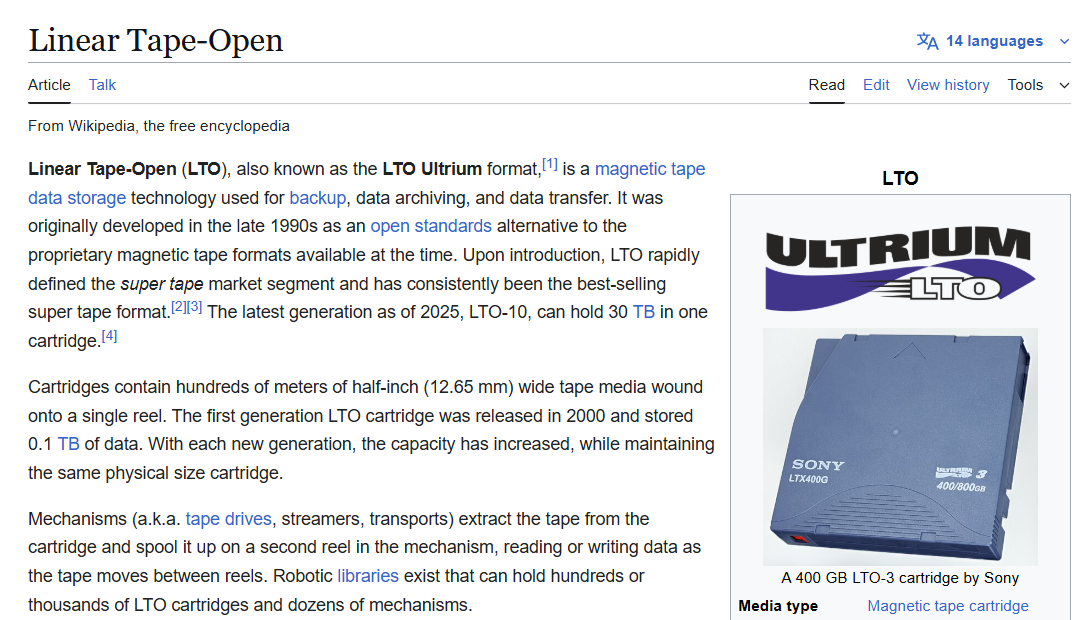
hi! what’s the future of LTO in film archiving?
Here’s what’s emerging as the future of LTO (Linear Tape-Open) in film archiving — in simple, practical terms with clear trends and trade-offs:
📦 1. LTO isn’t going away — it’s evolving
- LTO tape remains a core archival medium for long-term storage in media and film because it’s cost-efficient per terabyte, highly reliable, and offers offline, air-gapped security against cyberattacks.
- The technology roadmap shows planned future generations up through LTO-14 with massive capacity increases (roadmap targets suggest up to ~913 TB per cartridge).
📈 2. Capacity and performance are still climbing
Recent developments suggest the tape format is not stagnating:
- New LTO-10 tapes with 40 TB native capacity (up to 100 TB compressed) are shipping, giving archivists more space without changing drives.
- Tape libraries with tens of petabytes remain practical for studios dealing with huge 4K/8K film assets.
Trend: LTO will continue to scale to larger capacities and better transfer speeds with each generation, keeping it competitive for massive archives.
🧠 3. Integrated archiving strategies will dominate
Rather than only relying on LTO, archives — especially in film — are increasingly adopting multi-tier storage:
- LTO for cold, long-term storage
- Disk and cloud for active projects and quick access
- Intelligent metadata tagging and automated data workflows to manage how assets move between tiers.
This hybrid approach ensures archives stay searchable and resilient even as formats evolve.
🔄 4. Migration and obsolescence are real concerns
Tape media (and drives) have a limited lifecycle, and older generations lose software support over time. This means:
- Periodic data migration between tape generations is necessary.
- Without planned migration, older archives can become hard or expensive to recover.
For film archivists: build a migration plan into the archive strategy.
⚠️ 5. Alternative technologies are emerging
Current research and commercialization efforts indicate possible long-term successors (not replacements yet):
- DNA data storage: Extremely dense and stable over centuries — good for heritage and scientific archiving (still in early commercial stages).
- Other exotic mediums (optical glass, atomic-storage) are being studied for life-spanning archival. Research emphasizes the need to store decoders alongside the data to avoid format obsolescence.
These are complementary possibilities in the decade ahead, not immediate replacements.
🌀 6. Pros & Cons for film archiving
Advantages
- Low long-term cost compared with cloud/disk.
- Offline security protects against malware/ransomware.
- Well-understood and widely adopted in media workflows.
Limitations
- Access times are slower than disk or cloud.
- Generational compatibility requires careful management.
- Media refresh cycles (every ~7-10 years) are part of best practice.
🎯 Where LTO fits in future film archiving
Short-to-mid term (next 5 years)
- Still the default deep-archive backbone for major studios and archives.
- Continued roadmap improvements through LTO-14.
- Increasing integration with intelligent archive systems.
Mid-to-long term (10+ years)
- LTO will likely coexist with technologies like DNA storage or advanced optical media.
- These emerging formats may take on ultra-long-duration archives (heritage content), while LTO remains practical for large volumes where cost and accessibility matter.
Bottom line: LTO’s future in film archiving is stable and evolving. It’s not being superseded tomorrow — but it is being redesigned for a hybrid world where tape works alongside disk, cloud, and potentially DNA- or next-gen archival media to keep film archives robust, searchable, and safe.
what is DNA data storage?
DNA data storage is a way of storing digital information (files, films, text, images) by encoding it into synthetic DNA molecules instead of magnetic tape, hard drives, or optical discs.
Think of it as using biology as a storage medium 🧬.


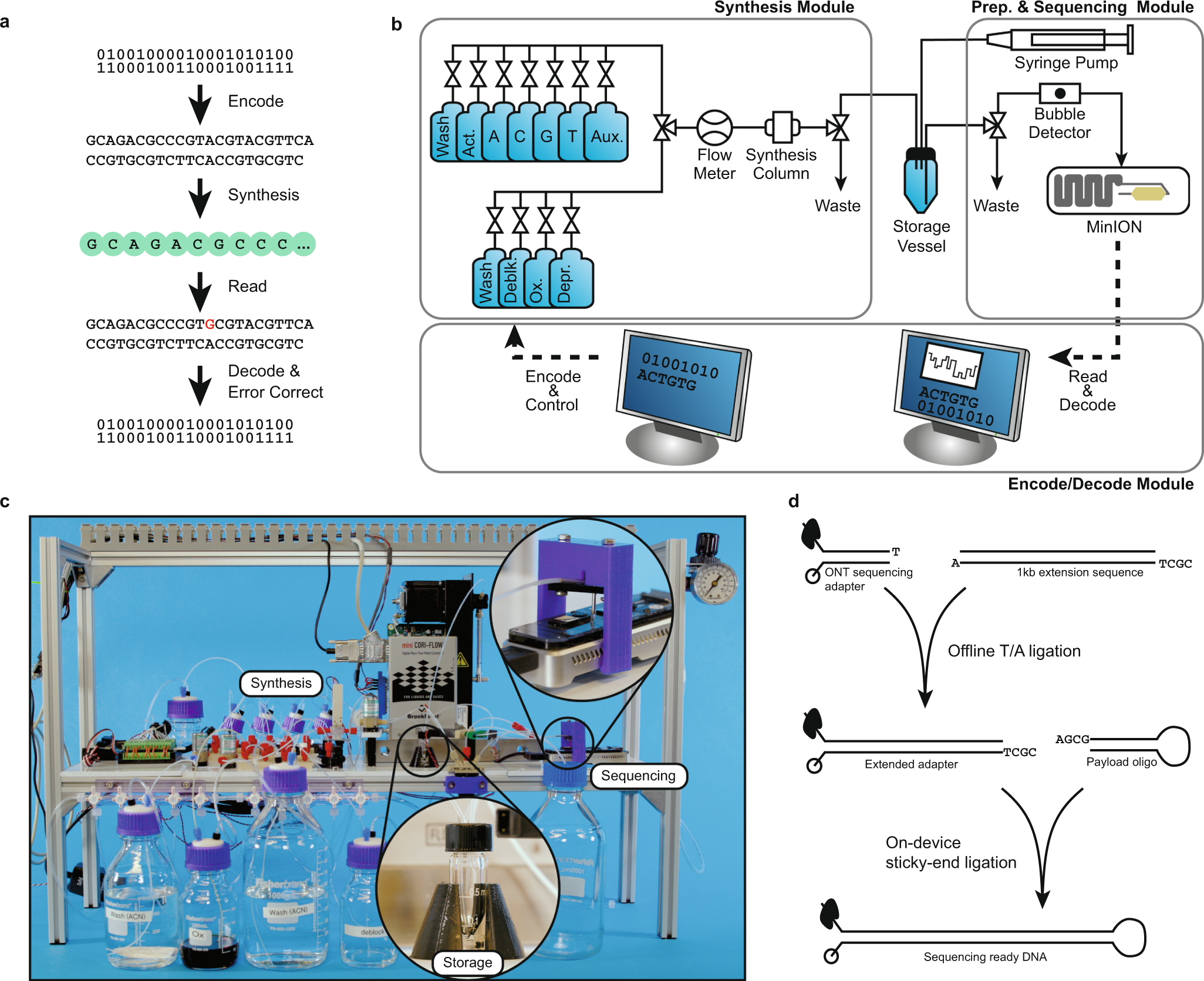
4
1. The core idea (in plain language)
All digital data is just 0s and 1s.
DNA has four bases instead: A, T, C, G.
So researchers map:
- binary data → sequences of A/T/C/G
- write those sequences as synthetic DNA
- store the DNA physically (in vials, dry capsules, or glass)
- read it later using DNA sequencing
- decode it back into the original data
2. How it works — step by step
Step 1: Encode
A digital file (say a film scan) is converted into binary, then translated into DNA bases.
Example (simplified):
00 → A
01 → C
10 → G
11 → T
Step 2: Synthesize
Machines chemically synthesize DNA strands with those sequences.
Step 3: Store
The DNA is stored:
- dry
- cold or room temperature
- often sealed in silica or glass
Properly stored DNA can last hundreds to thousands of years.
Step 4: Read & decode
When needed:
- DNA is sequenced
- sequences are converted back into binary
- original files are reconstructed
3. Why people are excited about it
🧠 Extreme density
DNA is the densest known storage medium.
To give scale:
- All the world’s data could theoretically fit in a few kilograms of DNA
- ~1 exabyte (1 billion GB) per cubic millimetre (theoretical)
⏳ Longevity
- DNA has survived tens of thousands of years in fossils
- Unlike LTO or HDDs, it doesn’t rely on electricity or spinning parts
🌍 Energy efficient
- No power needed for long-term storage
- No constant cooling like data centres
4. Why it’s not mainstream (yet)
💸 Cost
- Writing DNA (synthesis) is very expensive
- Reading DNA (sequencing) is cheaper but still slow
🐢 Speed
- Writing and reading take hours or days
- This is deep archive, not access storage
🧰 Infrastructure
- Needs specialised labs and equipment
- Requires future-proof decoding documentation
5. DNA storage vs LTO (for film archives)
| Aspect | LTO Tape | DNA Storage |
|---|---|---|
| Cost today | Low | Very high |
| Longevity | 15–30 years (with migration) | 100–1000+ years |
| Density | High | Astronomical |
| Access speed | Slow | Very slow |
| Maturity | Industrial standard | Experimental / early commercial |
| Best use | Working & cold archives | Cultural heritage, “forever” storage |
6. Who is using it (early stage)
- Research labs
- National archives (pilot projects)
- Tech companies exploring post-silicon storage
- Cultural heritage institutions thinking in centuries, not decades
No film archive relies only on DNA storage yet — it’s complementary.
7. The big archival idea behind DNA storage
DNA storage forces archivists to think differently:
- You must store decoders, instructions, and metadata alongside the DNA
- It’s not just about keeping the data
- It’s about ensuring future intelligibility
In that sense, DNA storage is closer to:
carving instructions on stone for future civilizations
8. The likely future (realistic view)
- Next 10–15 years:
DNA storage used for ultra-rare, culturally critical material
(national film heritage, master negatives, canonical works) - Alongside LTO, not instead of it
LTO = practical archival backbone
DNA = “vault of civilisation” tier
One-line takeaway
DNA data storage is not the future replacement of LTO — it’s the far-future safety vault for humanity’s most important data.
If you want, I can also explain:
- how DNA storage connects to film preservation ethics
- whether Indian film archives could realistically adopt it
- or how to conceptually frame this in an essay or artist book
