A comparative lecture on textile, sculpture, materiality and the transformation of space
MFA ART HISTORY · ADVANCED SEMINAR · APPROX. 50–60 MINUTES
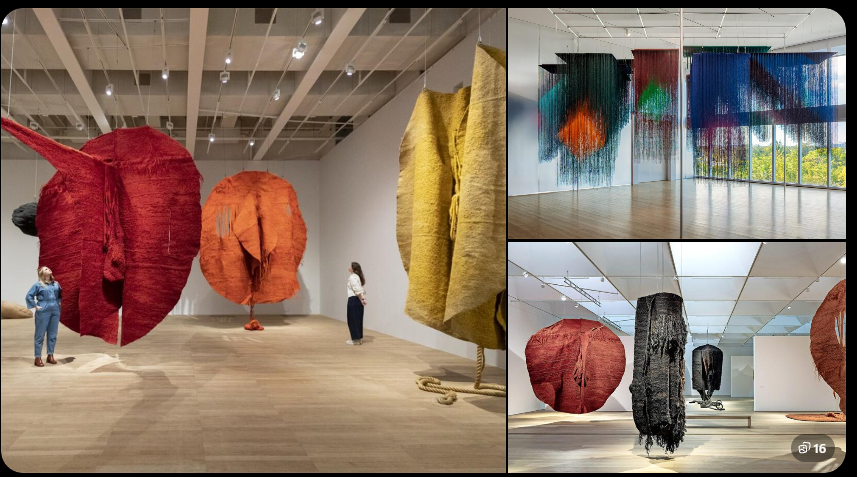
Magdalena Abakanowicz’s Otherworldly Sculptures Are Captivating Audiences at Tate Modern | Artsy
Olga de Amaral Wove Her Own Path. At 92 the Art World Is Catching Up.
Au musée, tissages en liberté – Le Courrier
16
Introduction: When does a textile cease to be a textile?
Let me begin with a question.
When we encounter a textile, what do we expect it to do?
We expect it to cover something. It might cover a body, a floor, a wall, a piece of furniture. It might protect us from the cold, communicate social status, identify a community, or serve a ceremonial function.
We also expect it to be understood primarily through its surface.
But what happens when a textile refuses to remain a surface?
What happens when it becomes a volume, an architectural intervention, an environment, or even an independent sculptural presence?
This is the question that brings us to two extraordinary artists: the Polish artist Magdalena Abakanowicz (1930–2017) and the Colombian artist Olga de Amaral (born 1932).
Both artists fundamentally challenged the distinction between art and craft, textile and sculpture, surface and space.
Both worked with fibre as an autonomous artistic medium rather than as a subordinate material.
And yet, their artistic languages are remarkably different.
Abakanowicz’s textiles often evoke the organic, the corporeal, the visceral and the existential.
De Amaral’s textiles frequently evoke the architectural, the luminous, the spiritual and the metaphysical.
One artist makes us confront the body and its vulnerability. The other invites us to contemplate the possibilities of light, rhythm and transcendence.
Today, I want to examine how these two artists expanded the vocabulary of textile art and, in doing so, contributed to a fundamental reconsideration of sculpture and installation in the twentieth and twenty-first centuries.
PART I — Historical context: The liberation of textile from craft
1. The historical hierarchy of materials
To understand these artists, we must first understand the historical position of textiles within Western art history.
For centuries, European academic traditions maintained a hierarchy of artistic disciplines.
Painting and sculpture occupied the upper levels. They were associated with intellectual authorship, individual genius and the production of autonomous works of art.
Textiles, embroidery, weaving and tapestry were frequently associated with domestic labour, decoration, anonymous production and women’s work.
This hierarchy was not universal. Many non-European cultures possessed sophisticated traditions in which textiles were central to political, spiritual and cultural life.
Consider the extraordinary textiles of the Andes, the ceremonial fabrics of Southeast Asia, the woven traditions of India, or the textile cultures of West Africa.
In these contexts, textiles were not merely decorative objects. They could communicate cosmology, social organisation, genealogy, political authority and sacred knowledge.
The modern Western distinction between fine art and craft therefore reflects a particular historical construction rather than an inherent difference between materials.
The emergence of modern fibre art challenged this hierarchy.
2. The postwar textile revolution
The 1950s and 1960s witnessed a significant international transformation in textile practice.
Artists began moving away from traditional tapestry conventions.
Instead of producing figurative or decorative images on a flat woven surface, they explored:
- Three-dimensional structures.
- The physical properties of fibres.
- Suspended and freestanding forms.
- Unconventional materials.
- Spatial relationships.
- The relationship between textile, architecture and the human body.
An important institutional moment was the 1969 Museum of Modern Art exhibition Wall Hangings in New York.
It brought together artists including Olga de Amaral, Magdalena Abakanowicz, Sheila Hicks and Lenore Tawney.
The exhibition helped establish fibre as a serious site of artistic experimentation rather than simply a category of decorative craft. Olga de Amaral+1
Notice something important here: these artists were not necessarily trying to make textiles more like painting or sculpture.
They were demonstrating that textile possessed its own distinctive possibilities.
Its flexibility, tactility, capacity for repetition, structural complexity and relationship to the body could generate entirely new forms of artistic expression.
This is the intellectual territory in which Abakanowicz and de Amaral operate.
PART II — Magdalena Abakanowicz: The textile as body, organism and environment
Magdalena Abakanowicz: ‘The godmother of installation art’ | Christie’s
Magdalena Abakanowicz’s Otherworldly Sculptures Are Captivating Audiences at Tate Modern | Artsy
Organic structures abakans magdalena abakanowicz exposition art blog – Artofit
8
3. Historical and biographical context
Abakanowicz was born in Poland in 1930.
Her formative years coincided with extraordinary political violence and social upheaval.
She experienced the Second World War, the Nazi occupation of Poland and the subsequent establishment of a communist state under Soviet influence.
She studied at the Academy of Fine Arts in Warsaw, initially receiving a conventional art education that included painting.
However, the political and institutional environment of postwar Poland was complicated.
Socialist realism had become an officially promoted artistic doctrine. Artists working outside its ideological expectations encountered considerable restrictions.
Abakanowicz’s movement towards abstract textile structures can therefore be understood within a larger struggle for artistic autonomy.
Her choice of natural fibres, irregular forms and unconventional sculptural structures allowed her to develop a language that did not conform to the dominant representational expectations of the period. National Museum of Women in the Arts+1
4. The Abakans: Giving fibre a body
The most important development in Abakanowicz’s early career was the creation of the works that became known as the Abakans.
Magdalena Abakanowicz: ‘The godmother of installation art’ | Christie’s
11
These were monumental woven structures, often made using sisal, hemp, wool, horsehair and other natural fibres.
But let us look carefully at what she was doing.
Traditional tapestry generally operates through a relationship between image and surface.
Even when a tapestry is exceptionally elaborate, it remains fundamentally organised as a plane.
Abakanowicz disrupts this relationship.
Her textiles protrude, curve, hang, fold and occupy space.
They are no longer representations of objects. They are objects.
Some appear like enormous organic membranes. Others resemble animal bodies, anatomical structures, cocoons or fragments of an unfamiliar organism.
Their surfaces are rough, irregular and sometimes almost threatening.
They seem to possess an independent biological existence.
The distinction between inside and outside becomes particularly interesting.
A conventional textile has two surfaces: a front and a back.
An Abakan frequently creates an interior and an exterior.
It can envelop the viewer’s field of vision and produce a sensation of entering another physical environment.
This is an extraordinary transformation.
The textile becomes a spatial proposition.
The artist is no longer simply composing an image. She is constructing an environment.
The National Gallery of Australia’s account of her work describes the Abakans as enveloping installations that fundamentally challenged the pictorial and functional conventions of tapestry. digital.nga.gov.au+1
5. Materiality: Why fibre matters
Consider the materials themselves.
Sisal, hemp, jute and horsehair are not neutral materials.
They have particular physical characteristics:
- They are fibrous.
- They have irregular surfaces.
- They retain traces of their natural origins.
- They can be twisted, knotted, woven and manipulated.
- They can suggest organic growth and bodily texture.
Abakanowicz understood these characteristics as expressive possibilities.
Her material choices are not simply a matter of aesthetic preference.
They are integral to the conceptual content of her work.
The roughness of the material can evoke skin, bark, animal hide or decaying organic matter.
The irregularity of the weave resists the perfection associated with industrial manufacture.
Her textiles seem to have undergone a process of growth rather than simply having been manufactured.
This brings us to an important concept in contemporary art history: material agency.
The material is not merely something the artist uses to execute a preconceived idea.
Its properties actively participate in determining the form and meaning of the artwork.
6. From abstract textile to the human body
Wystawa prac Magdaleny Abakanowicz we Wrocławiu
14
During the 1970s, Abakanowicz increasingly moved towards figurative work.
Her sculptures began to suggest human bodies.
However, these were not conventional representations of the human figure.
They were often headless, fragmented, anonymous and repetitive.
Consider her Backs series and her later group sculptures.
What is the significance of the absence of the head?
The head traditionally signifies individuality, identity, intellect and psychological expression.
By removing it, Abakanowicz deprives the figure of many of the conventional markers through which we recognise an individual.
We encounter the body as a physical presence.
The bodies are often made using burlap or jute, reinforced with resin.
The material is particularly significant because it retains the roughness of the textile while acquiring the rigidity of sculpture.
The human body becomes almost indistinguishable from the material that constitutes it.
Her work also explores the tension between the individual and the collective.
Her experiences of twentieth-century political violence and mass movements informed her interest in crowds, conformity and the vulnerability of individual identity.
Her Crowd works are particularly powerful in this regard.
They present the human collective as both a social phenomenon and a potentially frightening organism. Artist Bio – Nasher Sculpture Center+2
An important question for students
Is Abakanowicz interested in representing human beings?
Or is she interested in examining what happens to human individuality when the body becomes part of a collective?
I would argue that the second question is more revealing.
Her sculptures are not portraits.
They are meditations on existence, vulnerability, anonymity and the human condition.
PART III — Olga de Amaral: The textile as architecture, light and metaphysical space
Olga de Amaral transforma el Malba en un laberinto universal – LA NACION
[국제전시리뷰] 섬유의 시간, 금빛의 기억-올가 데 아마랄 회고전, ICA 마이애미에서 개막 < 해외전시 < EXHIBITION < 기사본문 – 아트코리아방송
Olga de Amaral. Textile body | Meer
12
7. Historical and cultural context
Olga de Amaral was born in Bogotá, Colombia, in 1932.
Unlike Abakanowicz, whose early career unfolded within the political and cultural conditions of postwar Eastern Europe, de Amaral developed her practice in Latin America.
Her education is particularly interesting.
She initially studied architectural drafting in Colombia and subsequently studied fibre art and textiles at the Cranbrook Academy of Art in Michigan, United States.
She returned to Colombia and became involved in developing textile education and practice.
Her architectural training would become an important element of her artistic vocabulary.
For de Amaral, weaving is not simply the production of a surface.
It is a way of organising space.
Her work brings together several traditions:
- Modernist abstraction.
- Architectural geometry.
- Pre-Columbian textile traditions.
- Indigenous weaving knowledge.
- Latin American cultural memory.
- The material traditions of gold and ceremonial objects.
These influences are not simply decorative references.
They contribute to the conceptual and material foundations of her practice. Olga de Amaral on artnet+2
8. Weaving as architecture
Let us look at the second image you provided.
Olga de Amaral Wove Her Own Path. At 92 the Art World Is Catching Up.
What is immediately striking?
Unlike Abakanowicz’s monumental, dense, almost bodily structures, de Amaral’s work often employs an extraordinary sense of lightness.
We see threads, cords and suspended elements.
We see vertical repetitions.
We see layers of colour and transparency.
The work appears to divide the interior without completely enclosing it.
It produces a boundary that is simultaneously present and absent.
This is a crucial distinction.
In conventional architecture, a wall separates two spaces.
But what happens when the wall is made of thousands of suspended threads?
The boundary becomes permeable.
We can see through it, around it and sometimes partially into it.
The architecture remains visible, but its perception is transformed.
The textile creates a new spatial order without necessarily constructing a solid architectural enclosure.
This is one of de Amaral’s most important contributions.
She understands textile as a medium capable of reorganising the viewer’s experience of architecture.
Her large-scale works employ weaving, plaiting, knotting, wrapping and the layering of fibres to generate spatial structures. Institute of Contemporary Art, Miami+1
9. Colour, light and the immaterial
[국제전시리뷰] 섬유의 시간, 금빛의 기억-올가 데 아마랄 회고전, ICA 마이애미에서 개막 < 해외전시 < EXHIBITION < 기사본문 – 아트코리아방송
Forty Years of Olga de Amaral’s Shimmering, Sculptural Textiles | Artsy
13
One of the most fascinating aspects of de Amaral’s work is her engagement with light.
In some works, the textile becomes a vehicle for colour.
In others, it becomes a surface that reflects and absorbs light.
Her use of gold leaf is particularly important.
From the 1970s onwards, she increasingly experimented with gold and other metallic finishes.
Her works brought together linen, cotton, horsehair, gesso, acrylic, pigments and gold leaf.
The result is an unusual combination of the tactile and the luminous.
Gold is historically associated with sacredness, authority, wealth and ritual.
In pre-Columbian cultures, gold possessed ceremonial and symbolic significance that extended far beyond its economic value.
De Amaral’s use of gold therefore invites us to consider the cultural memory embedded in materials.
We should also avoid interpreting her gold surfaces merely as decorative luxury.
They are part of a larger investigation into the relationship between materiality and immateriality.
The textile is physically present, but light seems to dissolve its physical boundaries.
The surface becomes an event.
It changes according to the viewer’s position, the illumination and the surrounding architecture.
Her Estelas series is particularly significant in this regard. These gilded textile constructions evoke monumental and ceremonial forms, bringing together weaving, geometry and the symbolic associations of gold. Institute of Contemporary Art, Miami+2
10. The significance of pre-Columbian traditions
I want to pause here because this is essential to understanding de Amaral.
It would be inadequate to interpret her work simply as an example of Western modernist abstraction.
Her artistic vocabulary is informed by the material and cultural traditions of Latin America.
Consider the importance of weaving in pre-Columbian societies.
Textiles were sophisticated systems of knowledge.
They could communicate social status, cultural identity, cosmological ideas and relationships with the natural world.
Weaving itself was a form of intellectual and cultural organisation.
We should also consider the Andean quipu, a system of recording information through knotted cords.
The relationship between knots, repetition, colour and encoded meaning offers an interesting interpretative framework for de Amaral’s work.
Her textile structures can be approached not simply as abstract compositions but as systems of material memory.
The Venice Biennale’s 2024 presentation of her work explicitly drew attention to the relationship between her use of grouped and knotted fibres and the knowledge systems associated with the quipu. Olga de Amaral
This is an important distinction between abstraction as a supposedly universal language and abstraction that emerges from particular cultural histories.
De Amaral’s abstraction is not culturally neutral.
It carries histories of material practice.
PART IV — A comparative analysis
Now that we have considered the two artists individually, let us bring them together.
I want to organise the comparison around six themes.
11. The body versus architecture
Magdalena Abakanowicz: Textile Territorien
Abakanowicz
The textile becomes an organism. Its forms evoke the body, skin, anatomy and biological structures.
Lina Ghotmeh — Architecture | Olga de Amaral Exhibition, Fondation Cartier
De Amaral
The textile becomes architecture. It creates spatial divisions, layers, rhythms and permeable boundaries.
The first major distinction is the relationship between the textile and the body.
Abakanowicz’s textiles frequently suggest bodily forms, even when they are abstract.
They possess mass, volume and a physical presence that can be unsettling.
De Amaral, on the other hand, often creates a relationship between textile and architecture.
Her work does not necessarily represent architecture. It produces architectural experiences.
We could say that Abakanowicz brings the body into the space of sculpture, while de Amaral brings the textile into the space of architecture.
12. Material density versus material transparency
Artistic textiles by Magdalena Abakanowicz – DESA Unicum
Abakanowicz
Dense, rough, tactile, fibrous, organic.
De Amaral
Layered, suspended, translucent, luminous, rhythmic.
Abakanowicz often emphasises the weight and physicality of fibre.
Her surfaces are dense and textured.
They resist the eye. They invite us to imagine touch, but their scale and sometimes unsettling appearance can also create distance.
De Amaral frequently emphasises the capacity of fibre to produce transparency and luminosity.
Her threads may be arranged in such a way that the surrounding space remains visible.
The material becomes a mediator between the viewer and the architecture.
The contrast is not absolute: both artists work with density, texture and transparency. But their dominant visual strategies differ.
13. Repetition: Two different philosophies
This is perhaps one of the most interesting areas of comparison.
Both artists use repetition.
However, repetition functions differently in their work.
In Abakanowicz’s later figurative sculptures, repetition frequently evokes the collective.
Think of a group of anonymous human figures.
The individual is repeated until the group acquires an almost overwhelming presence.
The repeated body becomes a political and existential proposition.
In de Amaral, repetition is frequently structural and rhythmic.
The repetition of threads, knots, cords and woven units produces visual patterns and spatial relationships.
It is closer to musical rhythm or architectural modularity.
One could describe Abakanowicz’s repetition as existential and de Amaral’s as generative and compositional.
14. Time and the labour of making
Textiles possess a particular relationship with time.
Unlike many industrially manufactured objects, handwoven structures retain visible evidence of labour.
Every thread, knot, intersection and binding represents an action.
Both artists exploit this relationship.
In Abakanowicz’s work, the accumulated labour contributes to the sense of organic growth.
The textile appears to have developed through an extended process of physical formation.
In de Amaral’s work, the repetitive labour of weaving and binding becomes a means of producing rhythm, structure and contemplation.
There is an interesting conceptual parallel here.
Both artists transform repetitive manual labour into a form of artistic thinking.
The hand is not merely executing a design.
The hand is participating in the construction of knowledge.
15. Cultural memory and political history
Abakanowicz’s work is deeply connected to her experience of European twentieth-century history.
War, authoritarianism, collective violence and the vulnerability of the individual are important interpretative contexts.
De Amaral’s practice is informed by Colombian and broader Latin American histories, particularly pre-Columbian material traditions and the cultural significance of weaving and gold.
We should not reduce either artist to a straightforward national identity.
Their work is much more complex.
But their different cultural and historical contexts help explain why their textile languages developed in such distinctive directions.
Abakanowicz’s work often asks:
What happens to the individual in the face of collective power?
De Amaral’s work often invites us to ask:
How can material structures carry cultural memory and produce experiences of the sacred, the infinite and the contemplative?
16. The viewer’s experience
Finally, consider how we encounter their work.
With Abakanowicz, the viewer often experiences confrontation.
The sculptures can be intimidating, bodily and monumental.
They occupy space with considerable physical authority.
With de Amaral, the viewer is often invited into a more contemplative experience.
Her suspended works transform our perception of depth, light and architectural boundaries.
We move around them, look through them and perceive changes as our position shifts.
Both artists require us to move beyond the passive viewing of an image.
Their work is experienced spatially.
That is why their contributions to installation art are so important.
PART V — Beyond the art/craft distinction
17. Why these artists matter to contemporary art history
I would like to conclude the historical argument by returning to a fundamental question.
Why do we continue to distinguish between art and craft?
The distinction is particularly problematic when we examine the history of textiles.
Both Abakanowicz and de Amaral demonstrate that the intellectual possibilities of a medium are not determined by its historical classification.
A woven object can be as conceptually sophisticated as a painting.
A textile can function as sculpture.
A textile can reorganise architectural space.
A textile can communicate cultural memory, political history and philosophical ideas.
And perhaps most importantly, the material processes traditionally associated with craft can themselves become vehicles for contemporary artistic experimentation.
Neither artist needed to abandon weaving in order to enter the territory of contemporary sculpture.
Instead, they expanded the definition of sculpture.
This is the important historical achievement.
They did not simply make textiles that looked like sculptures.
They demonstrated that textile itself could generate an independent sculptural language.
PART VI — Close reading of your two reference images
Let us return to the two images you shared.
Magdalena Abakanowicz | Het Noordbrabants Museum
Image 1 — Magdalena Abakanowicz, installation view associated with Triptych – Great, Greater, Greatest.
Image 1: Abakanowicz
I want students to notice five things.
1. Verticality: The textile structures rise almost like monumental architectural columns. They establish a powerful vertical rhythm.
2. Surface: The surfaces are deeply textured, irregular and tactile. They appear almost geological.
3. Colour: The dark browns, blacks and reddish tones reinforce the organic and earthy character of the work.
4. Lighting: The dramatic illumination emphasises the relief and texture. The work appears to emerge from darkness.
5. Human scale: The visitors provide a reference for the extraordinary scale of the installation.
Notice how the textile occupies the wall but also seems to challenge the wall.
It is not simply decoration.
It is an intervention into architectural space.
Body and Thread: Olga de Amaral’s Cuerpo Textil at MALBA, Argentina — Hot Coffee Conversations
Image 2 — Olga de Amaral, suspended textile installation.
Image 2: De Amaral
Here I would direct attention to a different set of visual characteristics.
1. Suspension: The work hangs from above, creating a relationship between gravity and textile construction.
2. Transparency: The threads allow the surrounding architecture to remain visible.
3. Colour: The white, red and blue elements produce a chromatic rhythm that changes with the viewer’s position.
4. Movement: Even in a still photograph, the suspended elements suggest the possibility of movement.
5. Spatial permeability: The work creates an interior space without fully enclosing it.
The textile is simultaneously a boundary and an opening.
It does not divide the architecture in the conventional sense.
It produces a new way of experiencing it.
One important qualification: these are visual readings of the supplied installation photographs. The photographs alone do not establish the precise title, date or complete material composition of either installation. We should not assign specific artwork titles without consulting their original captions.
PART VII — Seminar discussion: Questions for MFA students
I would spend the final 10–15 minutes inviting students to consider the following questions.
Question 1 — Ontology of the medium
At what point does a textile become a sculpture? Is it the change in material, scale, function, or spatial relationship?
Question 2 — Material agency
Can we say that Abakanowicz and de Amaral allow the material itself to participate in the production of meaning?
Question 3 — Gender and artistic hierarchy
How have the historical associations of weaving with women’s labour influenced the critical reception of these artists?
Question 4 — Cultural specificity
How might we interpret de Amaral differently if we consider pre-Columbian textile traditions rather than approaching her work exclusively through European modernist abstraction?
Question 5 — Politics of the body
Is Abakanowicz’s treatment of the human figure a critique of authoritarianism, a meditation on biological existence, or both?
Question 6 — Architecture and installation
Can de Amaral’s suspended textiles be understood as temporary architecture? What happens to our understanding of space when the wall becomes porous?
Question 7 — Contemporary relevance
What do these artists teach us about the possibilities of materials that have historically been marginalised within the Western fine-art canon?
Conclusion: Two different ways of inhabiting space
Let me conclude with a proposition.
Magdalena Abakanowicz and Olga de Amaral represent two profoundly different approaches to the transformation of textile into contemporary art.
Abakanowicz takes fibre towards the body.
She explores its capacity to suggest organic life, vulnerability, anonymity and collective existence.
De Amaral takes fibre towards architecture and light.
She explores its capacity to create rhythm, transparency, cultural memory and contemplative space.
Both artists begin with something extraordinarily fundamental: the thread.
A thread is a simple material element.
But when threads are organised, interwoven, knotted, suspended, layered and repeated, they can produce complex structures.
They can become surfaces, volumes, bodies, walls, environments and experiences.
This is the extraordinary conceptual potential of textile.
And perhaps the most important lesson these two artists offer us is that the history of art does not have to be written exclusively through the histories of painting and sculpture.
There are other histories.
There are other materials.
There are other ways of thinking.
And sometimes, the most radical transformations in art history begin with a thread.
Key Takeaways
1. Abakanowicz transformed textile into organic sculpture. Her work investigates the body, biological forms, collective identity and political vulnerability.
2. De Amaral transformed textile into spatial architecture. Her work investigates transparency, light, geometry, cultural memory and the sacred.
3. Both artists challenged the art/craft hierarchy. They demonstrated that weaving could become an autonomous medium for sophisticated artistic enquiry.
4. Material is conceptual. Sisal, jute, horsehair, linen and gold leaf are not merely technical choices; their physical and cultural properties contribute to meaning.
5. Installation changes the relationship between artwork and viewer. Both artists make the viewer experience textile spatially rather than simply observe it as an image.
Suggested further reading and research
These are particularly useful resources for an MFA-level discussion.
Magdalena Abakanowicz — Artist and her Abakans
Study the development of the Abakans, their materials and their relationship to installation.Abakanowicz Foundation: Biography and chronology
Olga de Amaral – ARTBOOK|D.A.P.
Olga de Amaral — Weaving, architecture and cultural memory
A useful institutional introduction to her practice and its relationship to pre-Columbian traditions.Institute of Contemporary Art Miami: Olga de Amaral
Wall Hangings, 1969. Rare catalog from the seminal MoMA show of textile art. | Perfume Drinker
Wall Hangings, MoMA, 1969
Essential for understanding the international recognition of fibre art as a contemporary artistic practice.Venice Biennale 2024: Olga de Amaral
Olga de Amaral transforma el Malba en un laberinto universal – LA NACION
Olga de Amaral — Lisson Gallery
Excellent documentation of materials, individual works and her artistic statements.Artist biography and selected works
Call to Actions
For a postgraduate seminar, I would recommend three practical exercises:
- Material analysis: Ask students to compare sisal, jute, horsehair, linen and gold leaf in terms of texture, flexibility, weight, transparency and cultural associations.
- Spatial analysis: Have students sketch the architectural relationships created by the two installations, identifying boundaries, negative space, circulation and viewer position.
- Comparative essay: Ask them to write 1,500 words on the proposition: Textile is not simply a material used in sculpture; it is an alternative way of thinking about sculpture.
My recommendation as a teaching approach: Do not present these artists merely as two celebrated textile artists. Present them as two artists who fundamentally changed how we understand the relationship between material, body, architecture and space. That gives the students a much richer art-historical problem to investigate.